
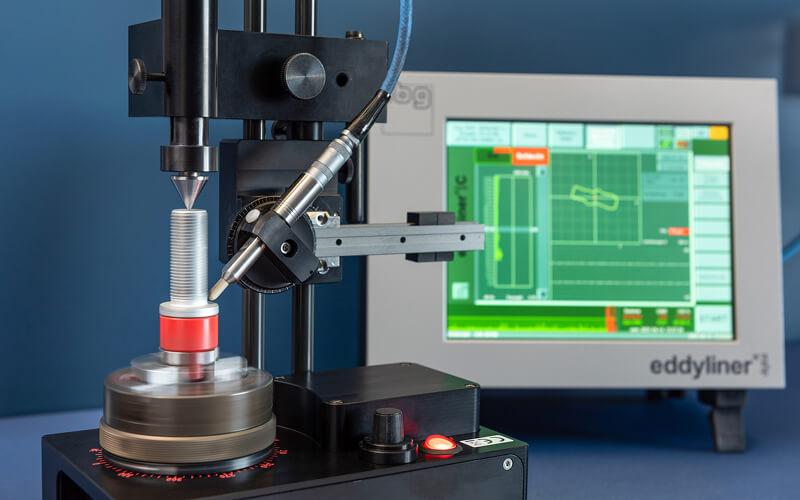
Quality inspections at Technomix.

Crack testing

Crack testing is used to detect and assess cracks or crack-like defects in components and materials. The aim is to ensure structural integrity and minimise the risk of component failure at an early stage.

Crack testing

Detecting cracks early – ensuring integrity

Cracks are among the most critical defects in technical components. They can result from material fatigue, forming processes, heat treatment, grinding or mechanical overload. If they remain undetected, they can propagate under load and lead to loss of function or fracture.

Crack testing is therefore a central part of quality assurance in safety- and function-critical applications. Depending on material, component geometry and suspected crack location, different test methods are used to ensure reliable detection.

Which crack types can be detected?

Within crack testing, the following defects can be detected, among others:

  • Surface cracks due to mechanical or thermal loading
  • Near-surface crack indications in edge zones
  • Fatigue cracks in dynamically loaded components
  • Grinding and hardening cracks after machining or heat treatment processes

The choice of suitable test method depends on the material, component thickness, accessibility and the respective quality requirements.

Methods used

Crack testing is not a single method but an inspection objective. Depending on application and material, different non-destructive methods are used:

For rotationally symmetrical series components, crack testing can also be integrated into fully automated inspection systems. Our inspection machines can include, for example, an integrated acoustic inspection unit for automated crack detection.

Typical use cases for crack testing

Crack testing is used in particular:

  • After mechanical machining or grinding processes
  • After heat treatments
  • During incoming goods control
  • During series production
  • As part of complaint analyses
  • During maintenance of safety-relevant components

Depending on requirements, inspection can be performed as sampling or as 100% control.

Industries and application areas for crack testing

Crack testing is relevant in all industrial sectors where component integrity is critical to safety or function, including:

  • Automotive and supply industry
  • Aerospace
  • Mechanical and plant engineering
  • Rail vehicle technology
  • Energy and power plant sector
  • Metal processing and forging technology

The specific design of the inspection depends on the component, accessibility, lighting conditions and the respective quality requirements.

How crack testing is carried out at Technomix

Crack testing is performed on the basis of clearly defined inspection instructions and agreed defect catalogues. Depending on material, geometry and inspection objective, the suitable method is selected and integrated into your existing quality process.

In addition to manual methods, Technomix offers automated solutions to cover high volumes with reproducible inspection reliability.

Results are documented in a traceable way and, where findings occur, supplemented with image or profile data.

Organisational integration is handled within our quality management system according to DIN EN ISO 9001.

Final CTA

Contact & consultation on crack testing

Would you like to clarify whether crack testing is required for your component or which method is technically appropriate?

We will be happy to analyse material, geometry and load scenario together with you and recommend a suitable inspection concept – manual, semi-automatic or fully automatic.