
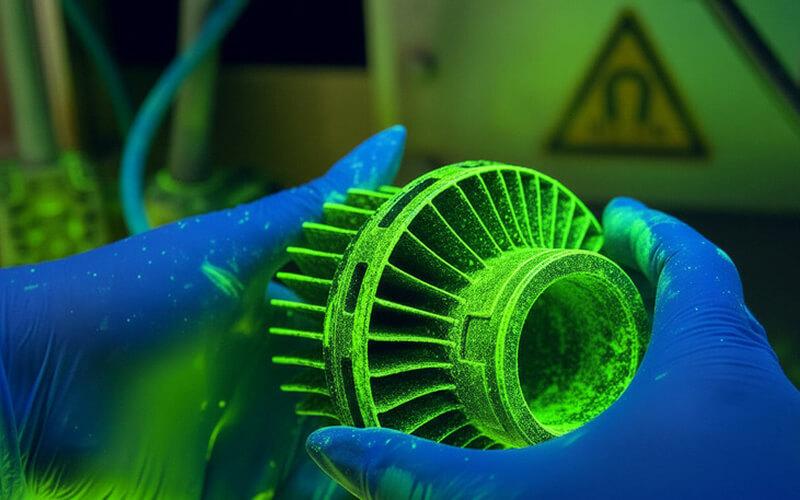
Non-destructive testing (NDT) at Technomix.

Magnetic particle testing (MT)

Magnetic particle testing (MT – Magnetic Particle Testing) is a non-destructive method for detecting near-surface and surface-breaking defects in ferromagnetic materials.

Magnetic particle testing (MT)

Making near-surface defects reliably visible

Magnetic particle testing is based on targeted magnetisation of a ferromagnetic component. A magnetic field is introduced into the part – for example by current flow or via an applied yoke. This produces a directed magnetic flux in the material.

As long as the component is free of defects, this magnetic flux passes largely uniformly through the material. If, however, a surface-breaking or near-surface defect is present, the magnetic flux is locally disturbed at that point. Because of the discontinuity, magnetic field lines emerge from the surface and form a so-called leakage field.

While the component is magnetised, very fine ferromagnetic particles – either as dry powder or as a suspension in a carrier fluid – are applied to the surface. These particles respond to the emerging leakage fields and accumulate selectively in the disturbed region. This produces a visible particle indication that reflects the course and orientation of the defect.

The sensitivity of the test depends significantly on the orientation of the magnetic field relative to the potential crack direction. For a leakage field of sufficient strength, the magnetic flux must intersect the defect as nearly perpendicular as possible. For this reason, several magnetisation directions are often applied in practice – for example longitudinal and transverse fields – to reliably detect defects of different orientation.

Evaluation of the indication is performed while magnetisation is maintained, because the leakage field is only effective in this state. The shape, length and intensity of the particle accumulation provide indications of the location and extent of the defect in the edge zone of the component.

In this way, magnetic particle testing enables reliable inspection of surface-breaking and near-surface cracks in ferromagnetic materials – non-destructively and with immediate visual feedback.

Which defects or characteristics are inspected?

Magnetic particle testing can detect the following defects in particular:

  • Surface-breaking cracks, for example due to fatigue or forming processes
  • Near-surface cracks and crack indications that are not visually detectable
  • Bonding defects, overlaps or laps in forged and rolled products
  • Grinding or hardening cracks due to thermal or mechanical loading

Advantages of magnetic particle testing at a glance

Magnetic particle testing is an established method for reliably detecting surface-breaking and near-surface defects in ferromagnetic materials. It is convincing in particular thanks to the following properties:

  • High sensitivity, especially for cracks in the edge zone of the component
  • Immediate visual indication without complex measurement or signal interpretation
  • Fast execution, suitable for individual parts as well as for series inspections
  • Non-destructive testing without impairing component function

In which application cases is magnetic particle testing appropriate?

Magnetic particle testing is used in particular when surface-breaking or near-surface cracks in ferromagnetic materials must be reliably detected. Typical application cases are inspections after forging, forming or heat treatment processes as well as after mechanical machining.

It is suitable both for in-process inspection and for final inspections of safety-relevant components, as well as for inspections within maintenance, damage analyses or complaint handling.

In which industries is magnetic particle testing typically used?

Magnetic particle testing is used wherever safety- or function-relevant components made of ferromagnetic materials must be reliably inspected for cracks, including:

  • Mechanical and plant engineering
  • Automotive and supply industry
  • Aerospace
  • Rail vehicle technology

Actual suitability depends on the material, component geometry, defect orientation and inspection requirements.

Which norms and standards are relevant?

Magnetic particle testing is carried out in accordance with the applicable standards and customer specifications, for example according to DIN EN ISO 9934 or comparable international rule sets.

Contact & consultation on magnetic particle testing

Would you like to clarify whether magnetic particle testing is suitable for your component or application?

We will be happy to support you in assessing your inspection requirements, selecting suitable magnetisation procedures and performing the test in a norm-compliant way according to specifications and customer requirements. Send us your technical documents or align directly with our team – we review feasibility and give you a transparent assessment of inspection effort and boundary conditions.