
Non-destructive testing (NDT) at Technomix.

Ultrasonic testing (UT)

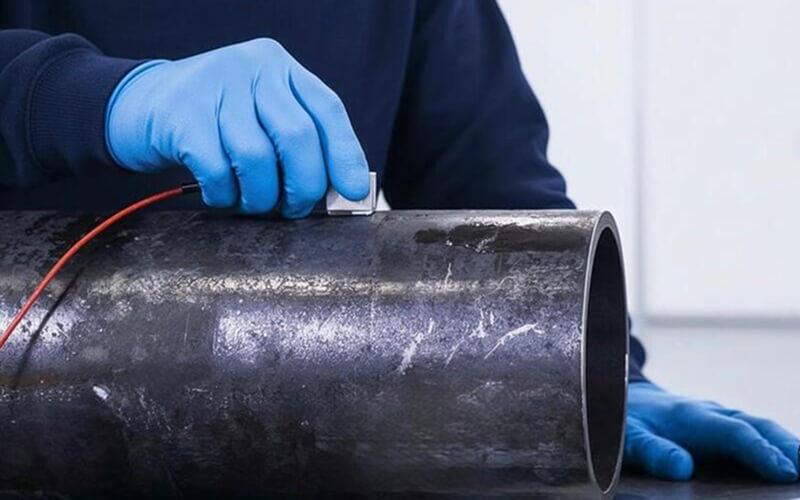
Ultrasonic testing (UT – Ultrasonic Testing) is a non-destructive method for detecting internal and near-surface defects in materials and components.

Ultrasonic testing (UT)

Detecting internal defects – material-friendly and precise

Ultrasonic testing uses the physical propagation of high-frequency sound waves in solid materials. Short ultrasonic pulses are coupled into the component via a suitable probe. To ensure reliable sound transmission, a coupling medium – for example a gel or a liquid – is applied between the probe and the component surface.

The coupled sound waves propagate directionally in the material. As long as the material is homogeneous, sound propagation is uniform. If, however, the sound pulse encounters an interface with different acoustic properties – for example between base material and air entrapment, at an internal crack or at a material discontinuity – part of the sound energy is reflected and returned to the probe as an echo.

The instrument records these echoes and displays them as a function of time and amplitude. From the measured transit time, the position of the reflecting structure within the component can be determined because the sound velocity in the respective material is known. Signal amplitude provides indications of defect size and character.

Depending on the inspection task, different test procedures are used. Pulse-echo testing is most common, in which a single probe both transmits and receives. For certain applications, through-transmission may be used, with transmitter and receiver arranged separately.

In this way, ultrasonic testing enables volumetric examination of the component. Unlike purely surface-oriented methods, irregularities located inside the material can thus be reliably detected and assessed without mechanically affecting the component.

Which defects or characteristics are inspected?

Ultrasonic testing can detect the following characteristics in particular:

  • Internal cracks and lack of fusion due to manufacturing or fatigue processes
  • Shrinkage cavities, pores or inclusions in the material volume
  • Wall thicknesses and material thicknesses, also for complex geometries
  • Delaminations or layer separations in multi-layer materials

Advantages of ultrasonic testing at a glance

Ultrasonic testing is one of the core volumetric methods of non-destructive inspection and offers the following advantages in particular:

  • Volumetric inspection, because internal defects in the material can also be detected
  • Large penetration depth, depending on material, frequency and component thickness
  • High localisation accuracy, in particular regarding position and extent of defects
  • Non-destructive method, suitable for safety-relevant components and recurring inspections

In which application cases is ultrasonic testing appropriate?

Ultrasonic testing is used when statements on the internal condition of a component are required. Typical application cases are inspections after casting, forging or welding processes as well as wall thickness measurements within manufacturing or maintenance measures.

It is suitable both for new parts and for recurring inspections in operation.

In which industries is ultrasonic testing typically used?

Ultrasonic testing is applied wherever the structural integrity of components must be assessed volumetrically, including:

  • Mechanical and plant engineering
  • Automotive and supply industry
  • Aerospace
  • Energy and power plant sector
  • Rail vehicle technology

The specific design of the inspection depends on the material, component geometry and inspection requirements.

Which norms and standards are relevant?

Ultrasonic testing is carried out in accordance with the applicable standards and customer specifications. Generally recognised rule sets include, among others:

  • DIN EN ISO 16810 – Non-destructive testing – Ultrasonic testing – General principles
  • DIN EN ISO 16811 – Non-destructive testing – Ultrasonic testing – Sensitivity and evaluation
  • DIN EN ISO 17640 – Non-destructive testing of welds – Ultrasonic testing

Selection of the standard to be applied depends on the component, inspection objective and contractual requirements.

Contact & consultation on ultrasonic testing

Would you like to clarify whether ultrasonic testing is suitable for your component or application?

We will be happy to support you in assessing your inspection requirements, selecting suitable procedures and performing the test in a norm-compliant way according to specifications and customer requirements. Send us your technical documents or align directly with our team – we review feasibility and give you a transparent assessment of inspection effort and boundary conditions.