
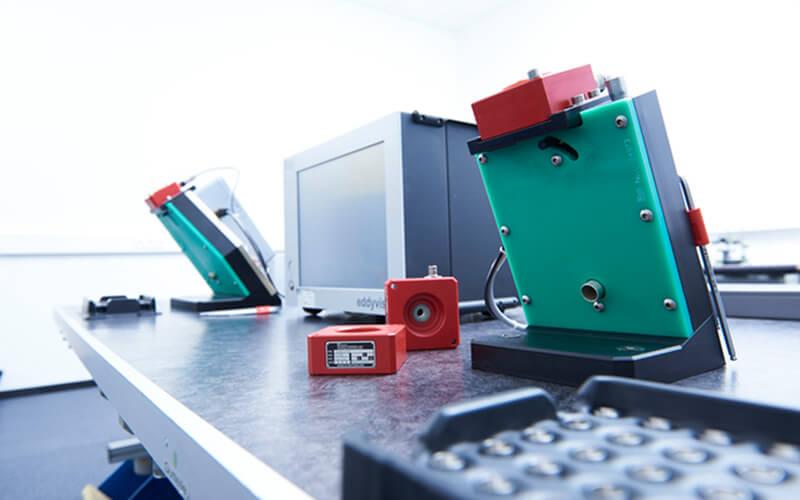
Non-contact evaluation of material properties and defects
Eddy current testing is based on electromagnetic induction in electrically conductive materials. A high-frequency alternating magnetic field is generated via a test coil. When this coil is brought near a conductive component, the magnetic field induces ring-shaped electric currents in the material – so-called eddy currents.
These eddy currents, in turn, generate their own magnetic field that counteracts the original excitation. In a homogeneous, defect-free material, a stable electromagnetic state is established. However, if the electrical conductivity, permeability, or geometric structure of the component changes – for example, due to a crack, porosity, or a change in microstructure – the distribution of the eddy currents is also locally affected.
These local changes have a direct effect on the impedance, amplitude, or phase of the measurement signal. The test probe detects these signal changes non-contact and transmits them to the evaluation unit. Conclusions regarding the location, extent, and nature of the irregularity can be drawn from the type and intensity of the signal deviation.
The penetration depth of the eddy currents depends on the material, electrical conductivity, magnetic permeability, and the selected test frequency. As the frequency increases, the penetration depth decreases (skin effect), making the method particularly sensitive to surface-near defects. By selecting an appropriate frequency, the test can be specifically tailored to certain edge areas of the component.
Depending on the testing task, different probe types are used, such as contact probes for spot inspections or continuous-pass coils for mass-produced components. Eddy current testing thus enables a fast, non-contact, and reproducible examination of conductive materials – both for crack detection and for assessing material properties or heat treatment conditions.