
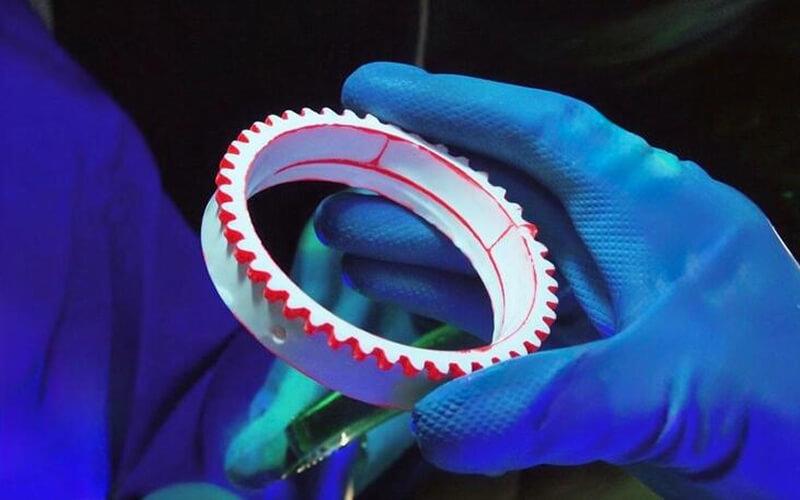
Reliably revealing surface-open defects
Penetrant testing is based on the physical property of low-viscosity liquids that penetrate very fine structures open to the surface via capillary action. A prerequisite for reliable testing is thorough cleaning of the component surface, as contaminants can hinder the penetration of the testing agent.
After pre-cleaning, a suitable penetrant is applied evenly to the surface. This penetrant has high wetting properties and penetrates surface-open cracks, pores, or other defects during a defined exposure time. The duration of the penetration time depends on the material, surface condition, and expected type of defect.
Next, the excess penetrant is carefully removed from the surface without washing out the penetrant trapped in the defects. This cleaning step is crucial for the quality of the subsequent indication.
This is followed by the application of a developer. The developer acts via capillary action in the opposite direction: it draws the penetrant remaining in the defect back to the surface. This produces a clearly visible indication with high contrast against the component surface. The shape and pattern of this indication correspond to the geometry of the defect.
Depending on the inspection requirements, visible (red-white method) or fluorescent penetrants are used, which are evaluated under UV light. The evaluation is performed visually based on the shape, length, location, and severity of the indicated defect.
Dye penetrant testing is suitable for metallic and non-metallic, non-porous materials and enables the reliable detection of very fine, surface-open defects – non-destructively and independently of magnetic or electrical material properties.